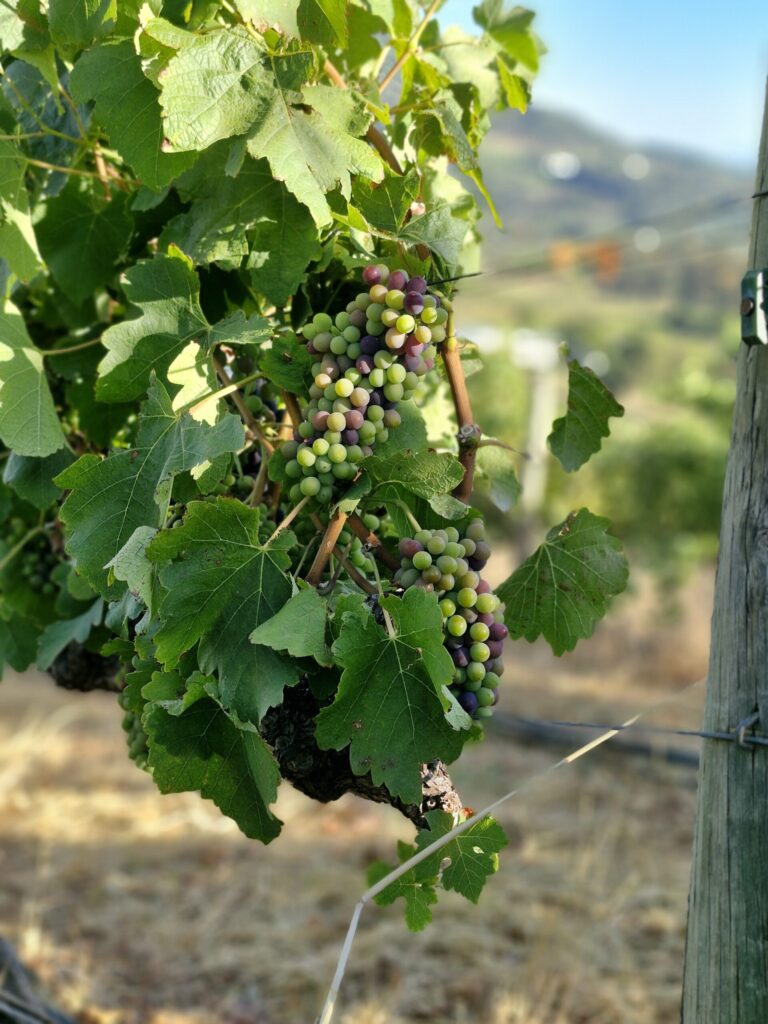
Making our way through summer, there is an interesting and observable process that occurs in the grapes called véraison. Véraison occurs at the onset of ripening, and is the point in berry development where the grape berries change colour: from green to black on red grapes and from green to light, translucent yellow-green on white grapes. At Oldenburg, the period of véraison begins in late December and continues through the different cultivars into the end of January. Some varietals are early ripening (like Syrah) while others ripen later in the season, with Cabernet Sauvignon usually the last one to complete the process. During this progression in ripening, the berry softens, sugar increases, the pips change from green to brown, the acid decreases and the flavours begin to develop.nn nnIn the red cultivars, the process of ripening is easy to follow – the grapes change colour from green to red, and about halfway through the process the clusters have a mix of green berries, red berries and shades in-between. This is often referred to as a “smartie box” due to all the various colours on the same cluster.nnWhen ripening has progressed to about 80%, Christo and the team begin green harvesting. They go through the blocks and evaluate the clusters, looking for uniformity in colour. If a cluster is found to have too many green and pink berries, then that bunch is behind in the ripening process. These bunches are cut and dropped to the ground. Bunches on shoots shorter than 30cm are also dropped, as shorter shoots do not have enough leaves to properly ripen the cluster. Furthermore, very thin shoots (thinner than a pencil) are reduced to only one bunch per shoot, to also ensure proper ripening.nn nnGreen harvesting is done to balance the fruit load, and ensure the berries ripen physiologically at the same time. It is not a regular commercial practice, but rather performed on ultra-premium wines, to further enhance the quality of the grapes and the resulting wines.
