
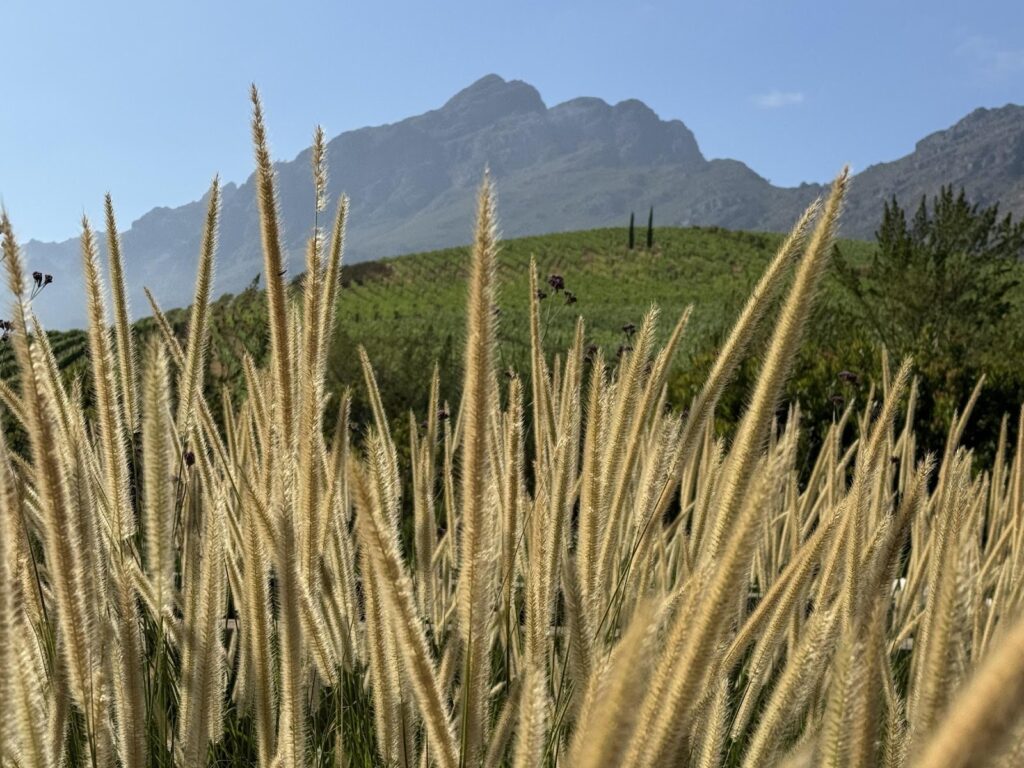
March on Rondekop carries a particular stillness. The harvest rush has passed, the cellar is full, and the Banghoek valley is turning gold as autumn approaches. It is a good moment to catch one’s breath.
This year, we had reason to be especially grateful for timing. The heatwave arrived mid-month, but by then our fruit was safely in the cellar. Had we been a week later, it would have been a different story. Timing in winemaking is everything, and this year, we got it right.
It has been an early vintage. Veraison began in late December, and the warm, dry season produced small, concentrated berries with thick skins. Exactly the kind of fruit that gets Nic excited. Christo and the vineyard team had everything picked with precision, block by block, parcel by parcel. Watching their work during harvest is one of the great pleasures of the year.
The cellar has never been busier. Our young Chardonnay, Cabernet Sauvignon, and Cabernet Franc blocks were harvested for the first time. It is always a slightly nerve-wracking milestone. You spend years preparing, and then the fruit arrives and you get your first real answer. Meanwhile, our older Cabernet and Syrah blocks are showing the mellowing influence of vineyard age: lower crop loads, smaller berries, and a depth that only time can give. Every tank, barrel, and vessel is in use.
One of the things I find most compelling about our approach is something you will never see on a label. Every parcel ferments with its own wild yeasts, microscopic organisms shaped by our soils, altitude, fynbos, and years of regenerative farming. They are Rondekop’s biological fingerprint. The vineyard strains lead the early stages of fermentation, delicate and expressive. As the alcohol rises, they step aside, and a second population of resident cellar strains, established over years of spontaneous fermentation, takes over. These are not yeasts from a packet. They are Oldenburg’s own, as much a part of who we are as our barrels and concrete eggs.
It sounds poetic, and it is. But wild fermentation has no safety net. Temperature shifts, nutrient levels, and the risk of a stuck ferment. It demands constant vigilance. This is where Nic and Lucillia come into their own. They watch, taste, adjust, and know when to intervene and when to step back. I am proud to say that every parcel fermented cleanly to completion this year. No drama, just quiet satisfaction.
Nic sees this vintage as another leap forward. The concentration of the fruit, the new young block components, and the greater parcel diversity give him a wider palette than he has ever had. Having tasted through the young wines with him, I share his optimism.
No two vintages are alike, because no two years carry the same fingerprint. The same soils, slopes, and mountain air, yet different weather, different ripening, different microbial communities. Each bottle records a moment that will not return.
You cannot forge Rondekop’s fingerprint. It belongs here. This place, this vintage, these yeasts. Ultimately unique.