
Happy New Year! In keeping with the times, I will start the year and this piece with a question or two to Chat GPT:
Me: Define Regenerative Farming in a way that references Merlin Sheldrake’s Entangled Life and applies it to viticulture?
GPT’s Answer: Regenerative farming, inspired by Merlin Sheldrake’s “Entangled Life,” involves cultivating a symbiotic relationship between plants, soil, and fungi to enhance ecosystem health. In viticulture, this approach integrates mycorrhizal networks and diverse plant cover to promote soil biodiversity, nutrient cycling, and resilience, fostering a more sustainable and interconnected grape-growing environment.
Me: What are mycorrhizal networks?
GPT: Mycorrhizal networks are intricate fungal networks in the soil that form mutually beneficial partnerships with plant roots. These networks facilitate the exchange of nutrients and water between plants, enhancing the overall health and resilience of the ecosystem. In viticulture, mycorrhizal networks play a crucial role in supporting grapevine growth and improving soil conditions for sustainable cultivation.
Why did I incorporate Merlin Sheldrake into my question? I wanted to see how GPT would handle a little complexity (well done, GPT – the answers are excellent). I also read his book a couple of years ago, which I found fascinating (definitely worth a read – filled with important thoughts and also hugely entertaining). It led to an epiphany: we needed to trust and better use nature to improve and move forward.
Regenerative Entanglement involves creating a system of practices with overall and specific sustainability in mind and entangling them with what nature does best – trusting its ability to build resilience – with the farm’s ecosystem more broadly and specifically its soil health – at its core. At Oldenburg Vineyards, we are deeply invested in the philosophy and implementation of Regenerative Farming practices. We only formally defined what we did last year, but the more we thought about it, the more we realised we were on a solid and sustainable path.
“The critical element of Regenerative Farming practices is protecting and improving soil health. We can create an overall healthier farm, vineyard and individual vine. The plants have an enhanced ability to guard against negatives (deficiencies and diseases), and their enhanced sub-surface environment also promotes better overall vine health and ultimately leads to optimisation of the quality of grapes produced”. Oldenburg Vineyards – Regenerative Farming Environmental Sustainability 2023. Over time, we will test the theory, but let’s now look at the current season as we head into an early harvest. After last year’s wet winter, we have had a relatively cool but bone-dry summer until January, when the heat spikes arrived.
These are generally ideal conditions for us – however, it has been a very windy season – with some quite vicious instalments of damaging south-easterlies. One such event around New Year managed to cause extensive leaf damage on several of the more exposed blocks. The heat spikes, the dryness, and the excessive winds have moved the harvest forward two to three weeks.
Despite more difficult conditions to normal (I am not sure there is such a thing as normal, however), our vineyards are coping well, and we have only intervened minimally with irrigation around the time véraison started, to give them a little assistance and reduce the level of stress to what we think is ideal and beneficial for them. In the leaf-damaged blocks, such as our Grenache block (which sits in the eye of the wind) we have started the process of green harvesting, which involves taking the number of bunches down to allow for a smaller canopy to achieve optimal ripeness. We have done this across many of our blocks, which will significantly lower our yields.
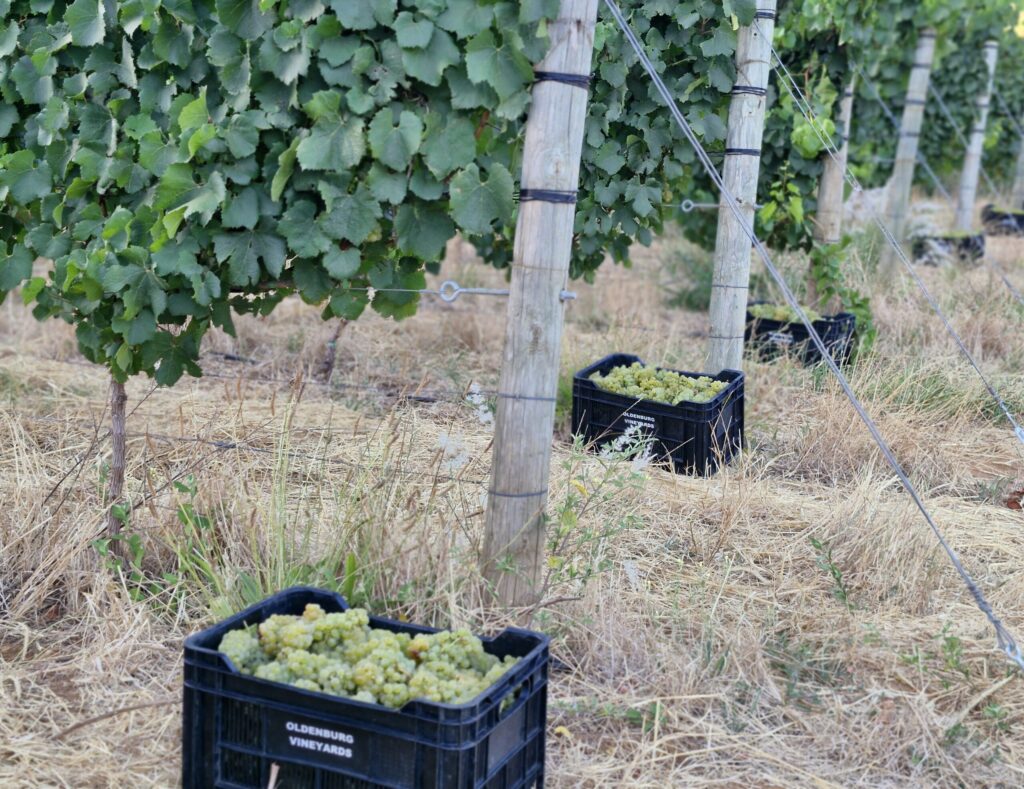
This year will be a significant trade-off of quality over quantity – a decision we will always make. As we head into the end of January and the first grapes head into the cellar, it is clear that Nic, Christo and their team have been alert to every detail – the fruit quality looks fantastic! Here’s to a spectacular Harvest 2024!
We concluded 2023 on a positive note with an exciting New Year’s Eve review by Anthony Mueller from Robert Parker’s Wine Advocate. During his inaugural visit to the farm in August, he bestowed some excellent scores upon the wines he sampled. Garnering attention from influential critics can be challenging, but Anthony declared that Oldenburg had earned a spot on his list as a noteworthy producer to keep an eye on. His ratings as follows:
Rondekop Per Se Cabernet Sauvignon 2020: 95+ Pts
Oldenburg Vineyards Chardonnay 2022: 94 Pts
Oldenburg Vineyards Cabernet Franc 2021: 93+ Pts
Oldenburg Vineyards Chenin Blanc 2022: 92+ Pts
Oldenburg Vineyards Merlot 2021: 92 Pts
Rondekop Rhodium 2020: 91+ Pts
“Bravo” was the word Mr. Mueller used a few times – Bravo to Nic and the entire team!
The Tasting Room has been very busy, and the new team under Greg’s leadership has settled in nicely. Please see the Interview segment to get to know Greg a little better. Freda, one of our new Somms, also received some great feedback: “The only thing that beats the breathtaking views are the people. We had the pleasure of Freda assisting us with our tasting. Her personality and knowledge made for the most enjoyable tasting. She truly made the whole experience next level”. Well done, Freda!
2023 was a pivotal year for Oldenburg Vineyards. As we commence 2024, and with harvest already upon us, we are motivated to regenerate and entangle ourselves in all it takes to deliver the potential that we know exists. Stay tuned, and all the best for a successful 2024 for you.