
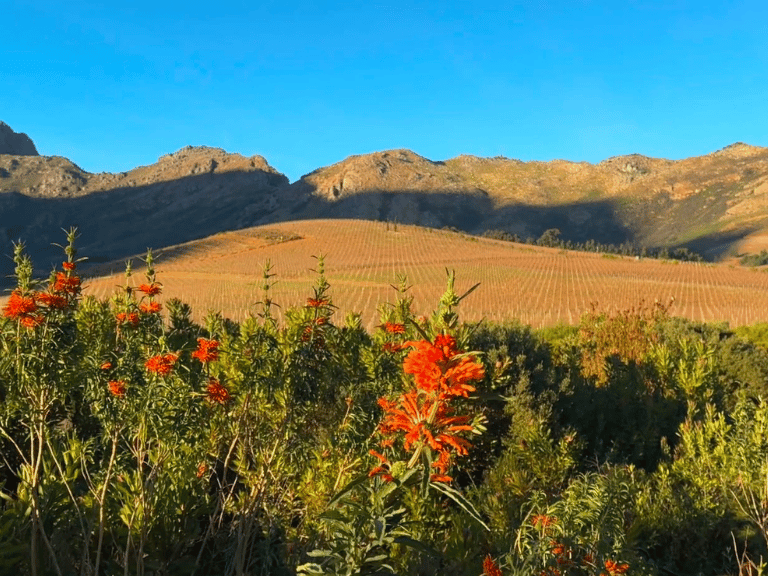
As I write this, the vineyards on Rondekop are bare and quiet, the vines settling into dormancy under a Cape winter before pruning begins. A few weeks ago, Vanessa and I were in the opposite season entirely, walking Italian rows in full midsummer growth, green and humming with life. There is something clarifying about leaving your own vineyards in their deepest sleep to visit someone else’s at the height of theirs.
One of the privileges of this industry is that it allows us to travel the world through wine — something I believe is genuinely important to do. But the deeper value is clearer still: these trips sharpen our view of our own farm and force us to think honestly about the business.
This June, Nic and Christo joined us on a working trip to Italy. We chose two regions we have long admired, Piedmont and Bolgheri, because each would test and confirm different parts of our thinking.
Piedmont was the inspiration. Nowhere on earth reads its terroir as obsessively as Barolo, where a stretch of hillside is carved into named vineyards because the growers are convinced that a single slope, and single aspect, changes everything in the glass. It is our own Rondekop Garden Philosophy pushed to its furthest conclusion — the belief that each block, and ultimately each vine, deserves to be understood on its own terms. Nebbiolo asks for patience and rewards restraint, which is a language Nic speaks fluently. We came home wanting to push our precision and our patience further still.
In Piedmont, we were hosted by Pio Cesare, our Italian distribution partner, who organised a few events to showcase our wines to their customers. Together we hosted a dinner at the Alba restaurant, Ape — Italian for “bees” — a wine-pairing evening for sixty-five guests on a perfect midsummer’s night. We poured our Chardonnay, Chenin Blanc, Cabernet Franc and Stone Axe. And I will admit to pride in watching them receive such a warm welcome, so far from home. Nor was the name of the place lost on me — a restaurant named for bees, while back on Rondekop, much of our regenerative work exists to keep that very life thriving between our own rows.
If Piedmont was the inspiration, Bolgheri was the confirmation. Here, within sight of the sea, the great Super-Tuscans are built on Bordeaux varieties — Cabernet Franc among them — grown in a maritime climate that tempers the heat. It is, in essence, the same conviction that sits behind our own Cabernet Franc: that these grapes, in a cool and ocean-influenced place, can speak with real elegance. To taste it done so beautifully is a reassurance that we are reading our terroir correctly.
One moment stayed with us above the rest. At Masseto, we watched their head viticulturist green-harvesting their Merlot — dropping healthy, perfectly good bunches to the ground so that those left behind could ripen in balance. It is precisely what Christo practices and precisely the instruction nobody enjoys carrying out. To see one of the most revered Merlot vineyards in the world making the same uncomfortable choice settled something for us. The discipline is right.
In both regions, growers were wrestling with the same questions around organic and regenerative farming — cover crops, soil life, and how far one can trust nature to lead. These were conversations between equals, and that in itself told me something.
If I had to draw a single thread from the whole journey, it is this: our terroir on Rondekop, our philosophy and our practices stand up alongside the very best in the world. We are doing a good job — I say that not out of complacency but with quiet conviction. And in the same breath, there is always room to improve, always a better way to be found, and we go looking for it with an open mind. We have returned to our sleeping winter vineyards, both reassured and restless.
Cheers,
Adrian Vanderspuy
Proprietor